
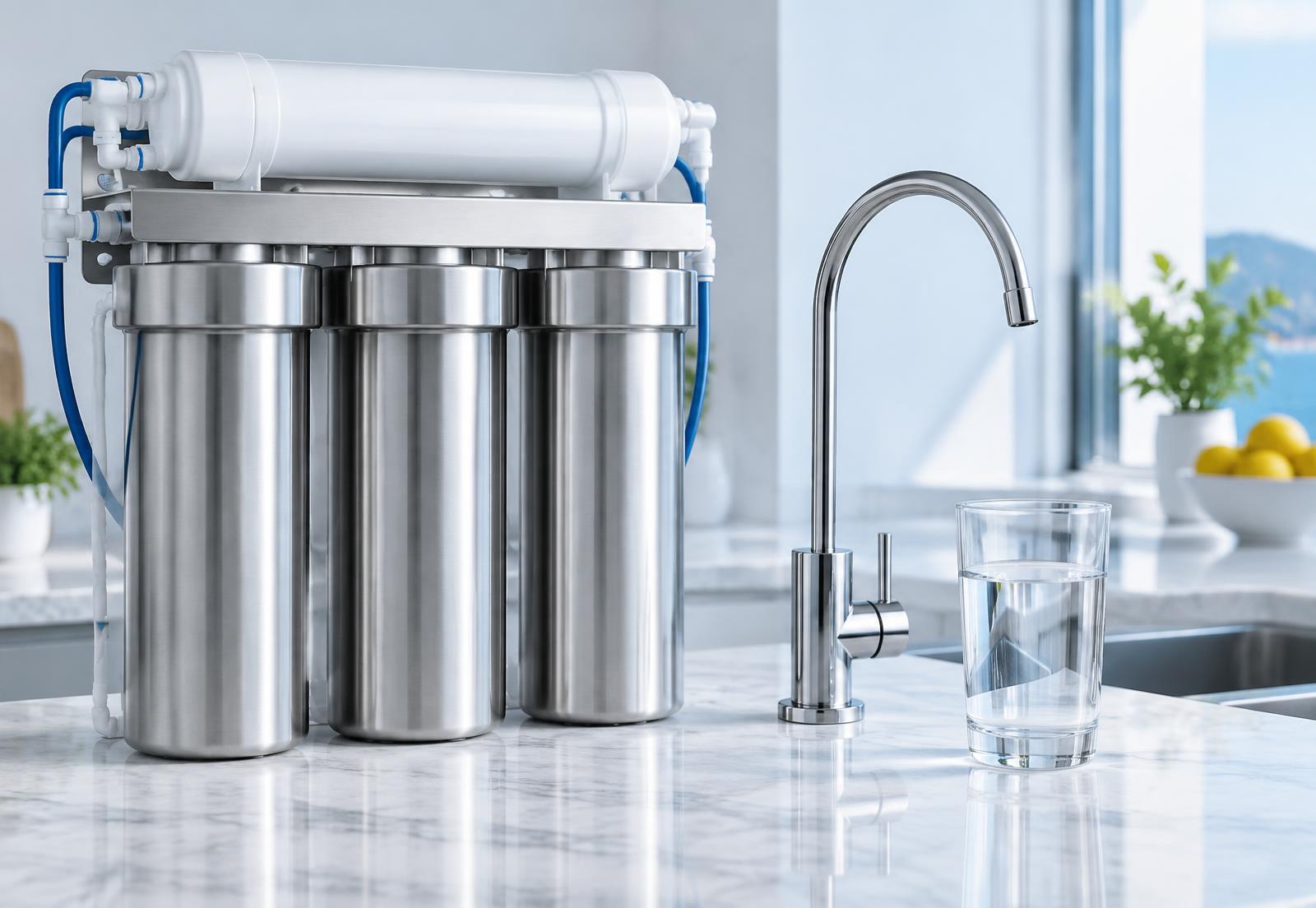
Reverse osmosis systems
Reverse Osmosis Water Filtration in Orlando, FL
Get cleaner, better-tasting water with a reverse osmosis system designed around your water quality and how you use it. iContracting Water provides RO solutions for homes, offices and commercial applications throughout Central Florida.
Serving Orlando and Central Florida
What Is Reverse Osmosis?
Reverse osmosis uses pressure to move water through a specialized semipermeable membrane. The membrane allows water to pass while rejecting many dissolved substances, which is why RO is commonly chosen when someone wants more highly treated water for drinking, cooking or another specific application.
Because the membrane separates water from what it rejects, an RO system produces two streams: the treated water you use, and a concentrate stream that carries the rejected substances to the drain.
01
Water in
02
Pre-filtration
03
RO membrane
04
Post-treatment
05
Treated water
Second output: concentrate / reject water, which carries the rejected substances away.
How an RO System Treats Water
- 01
Pre-Filtration
Initial filtration helps protect the RO membrane and reduce sediment and other particles.
- 02
Carbon Filtration
Depending on the system design, carbon filtration can help address chlorine and other water-quality characteristics.
- 03
RO Membrane
Water is pushed through a semipermeable membrane that rejects many dissolved substances.
- 04
Post-Treatment
Treated water may pass through additional filtration or conditioning depending on the system.
- 05
Storage / Delivery
Depending on the design, treated water may be stored and delivered through a dedicated faucet or connected to a specific application.
RO systems vary by design. Components and treatment stages depend on the water source, water quality, application and system configuration.
What Can Reverse Osmosis Reduce?
- Dissolved solids
- Certain salts
- Certain metals
- Certain minerals
- Some contaminants
- Certain PFAS compounds
- Other dissolved substances
RO performance depends on the specific contaminant, membrane, water chemistry, system design, pressure, flow and operating conditions. No reverse osmosis system should be assumed to address every contaminant.
Why Choose Reverse Osmosis?
Better-Tasting Drinking Water
RO can help reduce substances that affect taste and odor depending on the water source.
Drinking Water
Provides highly treated water at a dedicated drinking-water location.
Cooking
Useful for water used in food preparation and cooking.
Coffee & Beverages
Treated water may improve the taste and consistency of beverages depending on the source water.
Reduced Dissolved Solids
RO can significantly reduce many dissolved substances.
Targeted Treatment
Treat water where it is needed instead of necessarily treating the entire property.
Point-of-Use Reverse Osmosis
Point-of-use RO systems are designed to treat water at a specific location — most often an under-sink system connected to a dedicated drinking-water faucet. This approach can be appropriate when the primary goal is highly treated water for drinking and cooking.
- Kitchen sink
- Drinking-water faucet
- Coffee station
- Office break room
- Food-preparation area
RO Isn't Always the Same as Whole-Home Water Treatment
Whole-Home Treatment
Designed to treat water entering the property and can address broader water-quality concerns throughout the home or building.
- Showers
- Bathrooms
- Laundry
- Sinks
- Plumbing
- Whole-property water use
Reverse Osmosis
Typically used for highly treated water at selected points or specific applications.
- Drinking
- Cooking
- Coffee
- Food preparation
RO and whole-home treatment serve different purposes — and in some cases they work together as one strategy.
Can Reverse Osmosis Reduce PFAS?
Reverse osmosis can reduce many PFAS compounds when the system is appropriately designed, installed, operated and maintained. That qualifier matters: not every RO system performs identically, different PFAS compounds can behave differently, and water chemistry, membrane selection and maintenance all influence the result.
Testing can help determine what is present in a specific water source before any treatment decision is made.
Reverse Osmosis for Orlando Homes
In a Central Florida home, RO water is most often used where the water is consumed:
- Drinking water
- Cooking
- Coffee
- Baby formula preparation
- Ice
- Food preparation
Better Drinking Water for the Workplace
A single treated-water point can serve a whole team, without the handling and storage that bottled water requires.
- Office break rooms
- Employee kitchens
- Coffee stations
- Drinking-water areas
- Shared workplace kitchens
Reverse Osmosis for Commercial & Industrial Applications
RO may be considered where an operation needs more highly treated water — restaurants, hospitality, food preparation, beverage applications, commercial kitchens, offices, healthcare facilities, manufacturing and industrial processes.
These applications are not interchangeable, and they don't all use the same equipment. Larger systems require review of:
- Flow rate
- Daily water demand
- Peak demand
- Feed-water quality
- Required treated-water quality
- Recovery
- Reject-water management
- Pretreatment
- Equipment requirements
- Maintenance
What's Inside a Reverse Osmosis System?
Sediment Filter
Helps reduce suspended particles and protect downstream components.
Carbon Filters
May reduce chlorine and other substances depending on the media.
RO Membrane
The primary membrane responsible for rejecting many dissolved substances.
Storage Tank
Used in many residential point-of-use RO systems.
Post-Filter
Provides final filtration before the water reaches the faucet.
Dedicated Faucet
Delivers treated water at the point of use.
This describes a typical residential point-of-use configuration. Larger commercial systems can be configured very differently.
Understanding RO Water Recovery
Reverse osmosis produces two streams: treated (product) water and concentrate (reject) water. That's simply how membrane separation works.
The ratio between them depends on system design, pressure, membrane characteristics, feed-water quality and other factors — there is no single ratio that applies to every system, and we won't quote one before looking at your water.
For commercial and industrial systems
Recovery and concentrate management become significant design considerations as system size grows. Both affect operating cost, drain requirements and how the equipment is specified — so they belong in the conversation early, not after installation.
Your RO System Needs Regular Maintenance
An RO system performs the way it was designed to only while it's maintained. Depending on the system, that can include:
- Filter replacement
- Membrane replacement when needed
- Sanitization
- System inspection
- Checking connections
- Monitoring performance
- Reviewing water quality when appropriate
Maintenance intervals vary depending on water quality, water usage, system design and manufacturer requirements.
Your Local Reverse Osmosis Partner in Central Florida
Orlando-Based
Located in Orlando and serving Central Florida.
Authorized Puronics Dealer
iContracting Water is an authorized Puronics dealer.
Customized Solutions
Recommendations based on water quality and your specific application.
Professional Installation
Professional installation of selected RO systems.
Residential & Business Solutions
RO options for homes, offices, commercial properties and applicable larger facilities.
Ongoing Support
Maintenance and support after installation as needed.
Our RO Process
- 01
Consult
Understand your water concerns and intended use.
- 02
Evaluate
Review the water source, water quality, usage and application.
- 03
Recommend
Determine whether RO is appropriate and identify the right system configuration.
- 04
Install & Support
Professionally install the system and provide ongoing support and maintenance as needed.
Is Reverse Osmosis Right for Your Water?
The best way to determine the right treatment approach is to understand your water and how you plan to use it.
iContracting Water7648 Southland Blvd., Suite 100Orlando, FL 32809
Reverse Osmosis FAQ
Water Softener vs. Reverse Osmosis
| Feature | Water Softener | Reverse Osmosis |
|---|---|---|
| Primary purpose | Address hardness | Reduce many dissolved substances |
| Typical application | Whole-home or building water | Drinking / point-of-use or specialized applications |
| Treats hardness | Yes | Can reduce hardness, but that isn't its primary role |
| Drinking water | Not necessarily its focus | Common application |
| Whole-property treatment | Common | Depends on the system and application |
| Membrane | No | Yes |
| Brine / reject water | Depends on the system | RO produces concentrate / reject water |
These technologies can sometimes be used together, because they solve different water-treatment challenges.
Get Better-Treated Water Where You Need It
Whether you're looking for better drinking water at home, a filtered water solution for your office, or a larger RO system for a commercial application, iContracting Water can help you determine the right approach.
iContracting Water7648 Southland Blvd., Suite 100Orlando, FL 32809
Residential water treatmentOffice water treatmentCommercial water treatmentIndustrial water treatmentPFAS water treatmentContact iContracting WaterRefer a friend and earn $250